|
|
Introduction |
Concepts |
Exercises |
Resolution |
Case |
Discussion |
Print
|

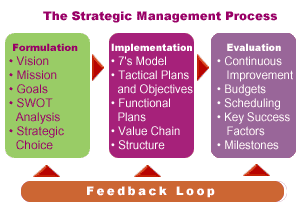
Perhaps you have read or seen interviews with famous entrepreneurs such as Bill Gates of Microsoft or Howard Schultz of Starbucks. If not, you can read about how Pete Slosberg and Mark Bronder started Pete's Brewing Company by going to the Keynote Entrepreneur Web site. Notice how Pete and Mark built one of the most successful specialty brewers in the land, achieving a multi-million dollar business and a firm position in the growing microbrew industry. As you read, keep in mind the questions Mark and Pete asked themselves as they started their business and recall the actions they took to in order to grow their operation. Maybe you can see some similarities between the co-founders of Pete's Wicked Ale and CanGo's CEO. Let's see if we can apply the general concepts of strategic management to better understand Liz's dilemma as she tries to describe her business formula. Strategic management has been defined as the future-oriented decisions and actions a company takes in order to achieve its mission. It is a continuously evolving process through which companies attempt to create a business plan that is more effective than those of their competitors. The figure below presents the general strategic management process. As the company's game plan, strategic management follows a planning process that includes:
Strategic management can also be characterized by the pattern in which strategy is created and implemented within the organization (top-down, bottom-up or consensus), and whether this process is purposeful or haphazard. Many organizations have emergent rather than deliberate strategies. An emergent strategy is one that results not from a formal planning process, but from the social and political interactions of organization members. Consequently, the strategy envisioned by each group involved in planning may not be what ultimately emerges from the process. The composition of the planning team and how they interact is crucial in determining the viability of the strategic management process. Good teamwork inevitably increases the likelihood of successful strategic planning. An organization's strategy and its planning process indicate the firm's position in the marketplace relative to its competitors. A firm can position itself either through low-cost production (selling the most products for the least amount) or through differentiation (selling a specialized product to a certain target market) and so attempt to carve out a unique position in the market. Some organizations take a very aggressive approach to the market by introducing new products and services (first movers) while others "copy cat" the market leaders (second movers and late-to-market movers). Still others defend their position vigorously, while others merely react to changes in their external environment. Remember that the most critical element of the strategic management process is the development of a competitive advantage. A competitive advantage is an advantage that earns the firm above average profits and is difficult for competitors to duplicate. Now let's apply some of these ideas to the situation at CanGo. Click "next" to proceed.
© 2002 by Prentice-Hall, Inc.
|